Davos, [Switzerland], January 21: India is done playing catch-up in artificial intelligence. At Davos, the message was blunt. Build AI Impact first, own the stack, and make safety non-negotiable.
India used the World Economic Forum Annual Meeting 2026 to quietly but firmly reset expectations. Union Minister Ashwini Vaishnaw laid out a comprehensive vision that stitched AI, semiconductors, infrastructure and energy into one coherent national strategy. No hype. No vague promises. Just timelines, numbers and intent.
The upcoming India AI Impact Summit is not designed as another talk-heavy conference. According to Vaishnaw, it has three clear objectives. Impact, accessibility and safety.
Impact comes first. The government wants AI models and applications that actually improve efficiency, raise productivity and generate a multiplier effect across the economy. This is about deployment, not demos.
Accessibility is the second pillar. India’s success with UPI and Digital Public Infrastructure has made the Global South pay attention. The same question is now being asked of AI. Can India build an affordable, scalable AI stack that works for developing economies? The AI Impact Summit aims to answer that with live models and real use cases.
Safety completes the triangle. Vaishnaw was clear that AI anxiety cannot be ignored. Guardrails, guidelines and safety frameworks are not optional extras. India plans to build its own regulatory and safety stack for AI, rather than importing rules written for very different societies.
Global leaders, tech CEOs and investors are expected at the Summit. Investment announcements and the rollout of India’s AI models are also on the agenda. This is positioning, plain and simple.
India now has close to 200,000 startups and ranks among the world’s top three startup ecosystems. That headline number matters less than what is changing underneath.
Over the past decade, focus has shifted decisively towards deep tech. Twenty-four Indian startups are designing chips, one of the hardest problems in technology. Eighteen of them already have venture capital backing. That is not patriotic optimism. That is market confidence.
This matters because chip design is not a side quest. It is foundational. Without it, sovereignty is a slogan.
India’s semiconductor roadmap is deliberately pragmatic. Nearly 75 percent of global chip volumes sit between 28nm and 90nm. These chips power electric vehicles, automobiles, railways, defence systems, telecom gear and most consumer electronics.
India is targeting this segment first. Master manufacturing here. Build yield, reliability and scale. Then move forward.
Working with partners like IBM, India has mapped a path from 28nm to 7nm by 2030, and 3nm by 2032. Vaishnaw said India expects to be among the top four or five semiconductor nations globally. Talent depth, full-stack design capability, expanding fabs and a booming electronics market make that ambition realistic.
Four indigenous chip manufacturing units will begin high-tech production this year itself. That is not a future tense problem anymore.
India AI Impact Summit and the Full AI Stack
A recurring theme in Vaishnaw’s remarks was control over the entire AI stack. He broke it into five layers. Applications, models, semiconductors, infrastructure like data centres, and energy.
India is working across all five. That is driven by necessity and scale. A tech-savvy population, a massive economy and globally embedded IT services firms leave no other choice.
The highest returns, Vaishnaw argued, sit at the application layer. Understanding enterprise workflows and applying AI effectively is where value concentrates. Indian IT firms have already pivoted. AI hiring is up about 33 percent, a signal that this shift is well underway.
While the world obsesses over trillion-parameter models, India is playing a different game. Nearly 95 percent of AI workloads today are handled by small models. For most enterprise needs, a 50-billion-parameter model is enough.
India is developing around 12 focused AI models designed to run on small GPU clusters. The logic is efficiency, affordability and reach. These models are meant to serve a very large population at low cost.
Sovereign AI capability is central to this approach. Vaishnaw was direct. If access to global AI resources is restricted tomorrow, India must not be stranded. Several of these models have already been tested in real-world scenarios. A full series launch is expected soon.
This is not isolationism. It is resilience.
AI is hungry. And not just for data. Around USD 70 billion in AI infrastructure investment is already confirmed and rolling out in India.
Energy is the bottleneck everyone prefers to avoid discussing. Vaishnaw did not. Data centres consume hundreds of megawatts. The human brain runs on a few watts. That gap is both a problem and an opportunity.
India has opened nuclear energy to private participation through the Shakti Act. This move is designed to support the full AI stack over the long term. Clean, stable energy is not optional if AI is to scale sustainably.
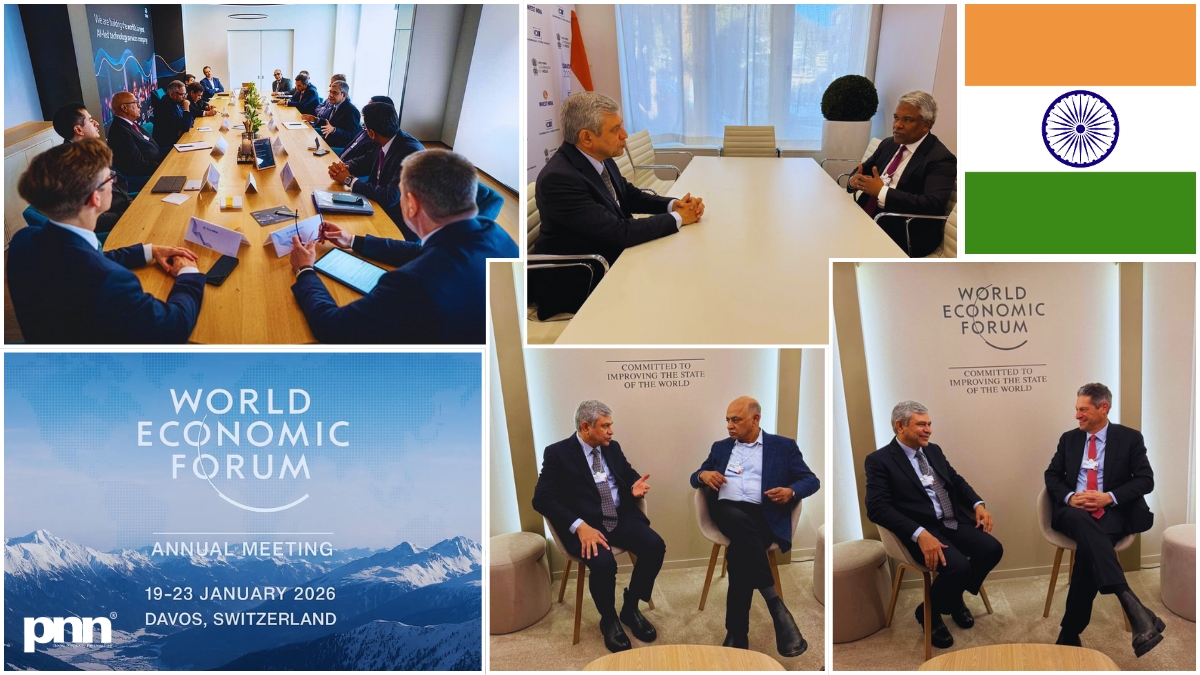
On the sidelines of Davos, Vaishnaw met Google Cloud CEO Thomas Kurian. Google is doubling down on India’s AI ecosystem, including a USD 15 billion AI data centre investment in Vizag, Andhra Pradesh, and deeper partnerships with Indian startups.
He also met Meta’s Chief Global Affairs Officer Joel Kaplan. Discussions focused on user safety, deepfakes and AI-generated content. Meta briefed the government on steps it is taking to protect users. India is clearly asserting itself as a regulator with leverage, not a passive market.
One of the sharper insights from Vaishnaw was the government’s role as a demand generator. In areas where commercial incentives are weak or unclear, the state will step in.
AI use cases are being developed for weather forecasting, agriculture and healthcare. Predictive and preventive healthcare is a particular focus, an area where India can realistically lead.
The government plans to fund applications built on sovereign AI models and support them with large-scale infrastructure. This approach is meant to drive adoption, strengthen talent pipelines and avoid the innovation stall that often follows pilot projects.
India’s AI Mission, much like its semiconductor programme, has been designed with industry input. Vaishnaw’s message to industry leaders was simple. Help build AI-ready curricula.
Graduates must be ready for AI-driven industry, just as earlier generations were prepared for IT services, semiconductors and 5G. Without skills alignment, even the best infrastructure underperforms.