Kagan–Soai duo recognised for non-linear effects and homochirality research
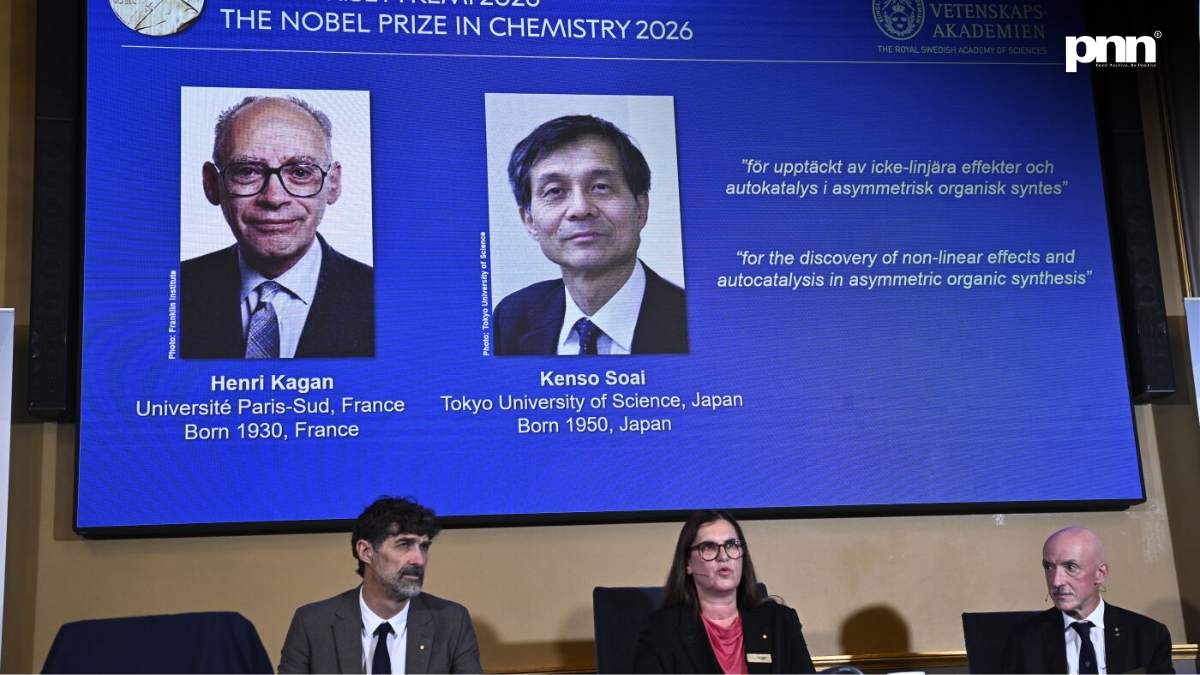
New Delhi [India], October 7: French chemist Henri B. Kagan and Japanese chemist Kenso Soai just picked up the Nobel Prize in Chemistry for 2026. The Royal Swedish Academy of Sciences made it official on October 7. They’ll split the prize money — 12 million Swedish kronor — right down the middle.
So, what did they do? Their research tackles a tricky question with big implications for biology and medicine: how do certain chemical reactions end up favoring one molecule over its mirror image? It’s like asking, “Why does nature pick one hand and not the other?”
Kagan figured out that some reactions can actually ramp up an existing preference for one molecular “hand.” Soai took it further. He showed that a reaction can reinforce that preference by making more of the substance that started it, kind of like a feedback loop.
Let’s talk about chiral molecules and homochirality for a second.
Look at your hands: same basic shape, but you can’t rotate one to match the other exactly. Chiral molecules are the same way. The two forms, called enantiomers, are mirror images.
Living systems depend on these forms. Proteins pretty much use only L-amino acids, while DNA includes a D-form of sugar. This selective use is what scientists call homochirality.
The real mystery is, how does such a strong preference happen in the first place? If the reaction doesn’t have a “handed” influence, you end up with equal measures of both forms. So, how does chemistry break that tie and move toward the clear dominance we see in life?
Here’s what Kagan discovered.
Back in 1986, he and his team showed that asymmetric synthesis can have non-linear effects. That means the relationship between the catalyst’s handedness and the product’s handedness isn’t straightforward. If you use a chiral catalyst, it helps tilt the reaction toward one enantiomer. But what if your catalyst is mixed, with both left- and right-handed forms?
Turns out, sometimes the product’s preference can be way stronger than you’d expect from just a proportional mix. Even a small imbalance in the catalyst, and you get a much bigger imbalance in the product. That’s a positive non-linear effect. Chemists use it to get a better handle on how catalysts interact and to fine-tune reactions.
Now, the Soai reaction.
Soai’s big find was asymmetric autocatalysis: the idea that the product of the reaction helps make more of itself, with the same “handedness.” His team showed in 1995 that even a tiny initial favoring — like just a 2% excess for one form — can snowball thanks to autocatalysis.
As the reaction moves forward, the product actively encourages more of itself to form. If you set it up right, this feedback can take a slight preference and turn it into major dominance.
By 2003, his group had published work showing super-strong amplification and asymmetric synthesis, without needing to add a special chiral ingredient upfront to tip the scales.
That’s why the Soai reaction matters: in systems where symmetry could be broken, tiny quirks or imbalances can become permanent thanks to chemical amplification. You don’t need an initial bias — once the system starts, either hand can win out.
How are Kagan’s and Soai’s breakthroughs different?
| Scientist | Main contribution | Why it matters |
|---|---|---|
| Henri B. Kagan | Non-linear effects in asymmetric synthesis | An existing preference can be amplified beyond a simple proportional response. |
| Kenso Soai | Asymmetric autocatalysis | The product helps generate more product, allowing molecular handedness to reinforce itself. |
Kagan explained how a modest preference, once in place, can get amplified in unexpected ways during a reaction. Soai revealed that the reaction product itself can drive the process, making one orientation snowball. Soai’s process is more about the reaction building its own preference over time.
Both discoveries are tied together — amplify a small preference, and if the reaction helps itself along, you get lasting bias.
Why does this matter for medicines?
Our bodies can sense the difference between two enantiomers, even if their atoms are identical. Sometimes one form is the active ingredient, and the other does little or even causes side effects. In other cases, both forms help.
But there’s no simple rule: you’ve gotta test each compound and see what’s what. That’s why chemists work hard to control which enantiomer they produce. Understanding these reactions helps scientists make drugs with greater precision. The purity is a big deal, but you still have to check the biological effects after production.
Did this help explain how life started?
The discoveries show chemistry can create and boost molecular handedness. This matters for understanding life’s origins, since nature depends on strong homochirality.
But the Soai reaction is a lab experiment, not exactly what happened in the wild. We still don’t know which reactions gave rise to the homochiral amino acids and sugars in life.
What Kagan and Soai really gave us is a new toolkit to explore these questions — a step toward figuring out how life’s remarkable molecular selectivity came to be.